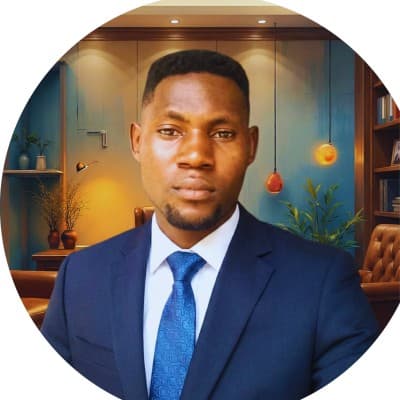
Open for selected work · West Africa Time (WAT, UTC+1)
Barnabas Tersue, software, field IT, and operations
I grew up in Benue State, Nigeria, taking radios apart and wiring small experiments before I ever saw a proper computer lab. That habit never left. Today I study Computer Science at FUTA, run SBAM TechConnect, and ship both digital products and physical installations. I study B.Tech Computer Science at FUTA, and I run SBAM TechConnect as a company that can write the product and still show up for the install.
Also searched as Barnabas Tersue Kpenhangen · Barnabas Tersue · Barnabas Kpenhangen
Early curiosity, village wiring, a first HTML page, then FUTA and the field in the same week.
Benue State, Nigeria
I grew up in Benue State, Nigeria. Long before I had a laptop of my own, I was the child who opened things. Old radio sets, torch lights, leftover cells, house wiring that other people treated as finished. Neighbours started calling me an engineer as a joke, then as a habit, because I would rather rebuild a circuit than sit still. I did not have a certificate. I had curiosity and a pile of parts that other people had thrown away.
The first real technical work I remember is electrical house wiring and small power experiments. I collected used cells from discarded radios and tried combinations until I could get a light or a small device to run in a village setting where grid power was not something you could count on. That is still how I think about infrastructure. If it only works in a perfect lab, it is not finished.
Secondary school is where computers stopped being a rumour. I started with basic HTML, the kind of first page that looks ugly and still feels like a door opening. I later joined programmes run by the Nigerian Communications Commission. The certificate mattered less than the confirmation: I learned quickly when someone put a real keyboard in front of me.
University gave the field work a language. Data communication is still the course I return to in my head when I am aiming a Starlink dish or designing how a campus app should talk to a backend. The same person who writes Next.js also pulls cable. That is a normal week.
Faith, integrity, and the way I work
How I try to work
I am a practising Roman Catholic. Faith is part of how I decide what work to take and how I treat people on a site or in a Slack thread. At the Federal University of Technology, Akure, I have served as a Bible Study Coordinator and taken leadership roles in the Nigerian Federation of Catholic Students.
The short version of the philosophy is simple. Grow in skill. Serve the person in front of you. Ship things that still work when the generator cuts. Stay honest when a deadline and a corner-cut are sitting in the same room. I want the work to make my family proud. I want the company to help Nigeria without pretending I can do that alone.
Integrity for me is practical. If I cannot maintain a system, I should not sell it. If a client needs a Virtual Assistant more than they need another dashboard, I say so. If a campus product needs trust and escrow more than it needs a new colour, the trust work comes first. Code and field work both leave a trail. I would like that trail to be one I can stand next to.
Education & leadership
Education & leadership timeline
Secondary education
Completed in Benue State, before university
Mbatiav Science and Technical School, Akpagher
Gboko area, Benue State, Nigeria
I attended a science and technical school, which suited the way I already worked with my hands. I served as Head Boy, which meant representing students, coordinating activities, and learning that leadership is mostly follow-up, not speeches.
Head Boy
University education
2023 to expected 2028
Federal University of Technology, Akure (FUTA)
Ondo State, Nigeria
I am a 300-level undergraduate in the Bachelor of Technology programme in Computer Science. The course that stays with me is Data Communication, because it sits right on the line between software, networks, and the physical world I already work in.
SBAM TechConnect
The company, the two divisions, and the hybrid job
SBAM TechConnect Solutions started as a way to stop splitting myself into fake job titles. People wanted either a developer or a technician. I was already both, plus the person who kept the operations calendar from falling over. The company is the structured version of that mix: engineering you can touch, software you can ship, and operations you can hand to a founder who is tired of being the whole company.
There are two divisions that share the same standard. Technical Field Services covers electrical work, CCTV, Starlink Gen 4, solar and hybrid power, smart-home setups, and general IT infrastructure. In the field I am usually introduced as Barnabas Tersue Kpenhangen. SBAM Digital Connect covers web and mobile products, cloud work, Web3 experiments, and product strategy. I still write production code. I still climb for a dish when that is the job.
The third skill, the one that surprises people, is operations. I have run supermarket-floor work at POA Mart, including inventory, staff coordination, customer handling, and POS routines. I have also been Operations Manager at DexTask, which means campus logistics, a trust and support team, and the unglamorous work of making a student marketplace feel safe. That is the same muscle I use when a founder needs a Virtual Operations Specialist rather than another contractor who only dumps tickets.
I train people by doing the work next to them. Technical skill without operations turns into a beautiful system nobody runs. Operations without technical skill turns into spreadsheets that lie. SBAM exists because those two failures are expensive, and because I have already lived both sides of the wall.
What you can actually hire
Four kinds of work, one person
Four kinds of work. If a brief needs two of these in the same week, that is a normal week for me.
Product engineering
Web and mobile products from first sketch to a store listing. Next.js, Flutter, Node, and the unglamorous work of making payments, auth, and admin tools behave.
Campus and marketplace platforms
iOS and Android release support
Dashboards and design systems
SEO-aware public sites like this one
Field IT and power
Physical systems that keep a home or a small business online: Starlink Gen 4, CCTV, routing, and hybrid solar. I specify, install, and leave you with something you can actually run.
Starlink Gen 4 installs and aiming
CCTV and local network setup
Hybrid solar and battery storage
Smart-home and site IT
Virtual operations
A founder-facing operations partner. Inbox, workflow design, vendor follow-up, and the weekly rhythm that stops a product company from running on panic.
Executive and startup operations support
Process and workflow design
Client communication systems
Team coordination across technical and field work
Web3 product experiments
Small, public Solana tools and hackathon products. Useful if you need someone who has shipped to a wallet user, not only written a white paper.
Public Solana utilities
Hackathon-to-production paths
Wallet-aware interfaces
Superteam community delivery
How a job usually runs
Four steps, no theatre
01
Listen without performing
I start with what is actually broken: a campus workflow, a dead network, a product that cannot take a payment. I ask for the real constraints.
02
Make the path visible
You get a written plan with scope and tools. If Starlink is the job, we treat it as Starlink.
03
Build where the work lives
Code in the repo. Cable on the roof. Operations in the calendar. I send progress in language a non-engineer can check, not only a commit hash.
04
Hand over and stay reachable
Documentation, a working system, and a clear way to reach me after, through the contact form or the desk in the corner.
Software plus operations
The stack I actually use
Software stack
Next.js on the front, Node.js on the back, React Native and Flutter for mobile, Supabase and Firebase for data, Cloudflare R2 for files. I pick this set because I can take a product from a browser tab to an App Store listing without changing religion every sprint. TypeScript keeps the larger codebases honest.
IT infrastructure and field operations
I install and look after Starlink Gen 4 kits, CCTV, routing, and hybrid solar with battery storage. The Lagos field work I did before university still shows up in how I size a system. Drawings and on-site installs are the same job.
Power and renewable field work
Hybrid inverter setup, lithium battery storage, and solar design for homes and small sites. I learned this with my hands, not only from a slide deck, and I still use it when a client needs the software and the power that keeps the software alive.
What I am studying next
Right now I am deepening cybersecurity, cloud, applied AI, data work, operations strategy, and virtual assistance. Those are the fields I am practising alongside the work that already ships.
At a glance
Software Engineering
Full-stack web (Next.js, Node.js)
Mobile (Flutter, React Native)
API work with Supabase
Cloudflare R2 and file storage
UI, UX, and product architecture
Web3 and Solana
TypeScript and JavaScript
Technical Operations and IT
Virtual assistance and executive support
Technical project management
Starlink Gen 4, CCTV, and routing installs
Hybrid solar and inverter configuration
Workflow and process design
Client support and relationship work
Daily operations and inventory routines
On-site and remote technical support
Projects and milestones
Selected live products and client deliveries. Filter by kind of work or search a name. More projects go up as they are ready to be public.
SBAM TechConnect Solutions (Founder and Tech Lead)
I founded SBAM as a dual company. The field side installs electrical systems, CCTV, Starlink Gen 4, solar, and smart-home kits. The digital side builds software with Next.js, Flutter, and Web3 tools. I own architecture, client conversations, project roadmaps, field crews, and the code. If a job needs a person who can sign off a pull request and a rooftop install, that is the job I built the company to take.
Next.js
Flutter
Node.js
Field operations
Project management
Business operations
One owner for software architecture and physical installation
Team leadership across technicians and developers
Client relationship and roadmap work, not only tickets
A working example of the hybrid professional model
DexTask is a campus super app for Nigerian universities: keke rides, gigs and errands with escrow, and a peer-to-peer marketplace. I architected the technical side around verified student identity, trust, and payment flow. I also ran operations: the Trust and Support team, campus logistics, product sequencing, and release coordination. It is the clearest proof I have that backend work and campus operations can sit in the same person without the product falling over.
Next.js
Node.js
Mobile app
Payment integration
Operations management
Team leadership
Trust-first architecture for a student marketplace
Led operations covering support and campus relationships
Logistics and supply coordination across campuses
Roadmap and feature sequencing, not only coding sprints
Lucacify (Lead Developer and Technical Project Manager)
Lucacify is a pet-care platform that connects owners with veterinarians and service providers. I led development of the web product and the iOS app: telemedicine, marketplace, booking, in-app payments, and location-based discovery. I also sat with the business team on launches and the operational flow behind a booking, so a visit can actually complete.
Flutter
Firebase
Google Maps
Telemedicine
Payments
Project management
Architecture through to App Store release
Technical project management with the business team
A technician-service platform for booking vetted professionals across Nigeria. The product covers home and business technical services, booking, tracking, and product ordering. I helped take it from a working web platform into an App Store release and the quieter work of keeping it stable after launch.
POA Mart (Supermarket Manager and Operations Lead)
Before the campus apps, I managed a supermarket floor. That meant inventory, staff rotas, customer handling, and the POS system that either works at 6pm or ruins the evening. If a process cannot survive a busy Saturday, it is not a process yet. That experience still shapes how I design workflows for technical teams.
Operations management
Inventory
POS systems
Client relations
Staff coordination
Daily floor management
Inventory and supplier coordination
POS and store routine ownership
The operations base I still use in software projects
NextTux and FUTA Online Bookshop
Campus products with a practical bias. NextTux (formerly RUNNIT) is aimed at student tasks and a campus service economy. FUTA Online Bookshop is built so academic materials and exam prep can be found through search, not only through a WhatsApp group that disappears at the end of the semester.
Platform design
Campus marketplace
SEO architecture
Education
Student-community products with a path to independent income
Search-first information architecture for academic content
Web3 and Solana public tools
Public Solana experiments: live prediction play, wallet-related utilities, and hackathon products that made it out of the slide deck.
Solana
Web3 UX
Real-time game loops
Hackathon delivery
Public deployments for real users, not only demo day
Includes Solana Price Clash and Solana Balance Checker
A sample of commercial and concept work: finance communications, dashboards, and design systems. These are pieces from live delivery, useful if you want to see how I handle information-heavy interfaces.
Next.js
Design systems
Dashboards
Content platforms
Speed, reliability, and interfaces that help someone decide
A regular release cadence across more than one domain
LocatorFi, Echo Chamber, SBAM Tech, and Solana Price Clash sit in this bucket, along with Superteam hackathon work. More public drops go up as they are ready. I would rather ship a small tool people can open than announce a protocol that does not exist yet.
Solana
Web3
Superteam
Mobile
Shipped: LocatorFi, Echo Chamber, SBAM Tech, and Solana Price Clash
When I am not in a repo or on a roof, I watch films, read, and play motor racing or taxi games. A lot of the useful ideas show up in the quiet, which is why I protect unstructured time instead of filling every hour with a status meeting.
In the next five years I want SBAM TechConnect to grow past a tech shop. The long plan includes transportation, food businesses, and processing, still rooted in Nigeria: build the system, then stand next to it.
If you are a founder, a campus operator, or a family choosing a Starlink kit, the useful next step is a specific brief. Tell me what is failing today. I will tell you whether I am the person for it.
Straight answers
Questions people actually send
Who is Kpenhangen Barnabas Tersue?+
I am a Nigerian full-stack engineer, field technician, and founder of SBAM TechConnect. I study B.Tech Computer Science at FUTA (300 level) and I take on software, infrastructure, and operations work for campuses, startups, and small businesses.
What can I hire you for?+
Product engineering (Next.js, Flutter, Node), field IT (Starlink Gen 4, CCTV, solar and hybrid power), and virtual operations support. A brief can be one of those, or all three.
How do I contact you?+
Contact is the last section, at the bottom of this page. Use the form there, email hello@sbamtechconnect.com, or open the desk in the corner for a quick text or voice chat. GitHub, X, and LinkedIn are linked in the header.
Is the desk in the corner a real person?+
It is a site assistant. Text answers questions about the work, projects, and how to reach Barnabas. If you want a part of this page, name the heading, such as Services or Contact. Voice greets you and closes the call when the conversation is done.
Is SBAM TechConnect only software?+
No. SBAM has a field division and a digital division. One company, two kinds of delivery, one standard for finishing the job.
Get in touch
Send a brief: what is broken, what you want built, and when you need a human reply. For a quick question, use the desk in the corner. Text or voice, same conversation.
I work in West Africa Time (WAT, UTC+1). Email, the form, or the desk in the corner all reach the same person.